
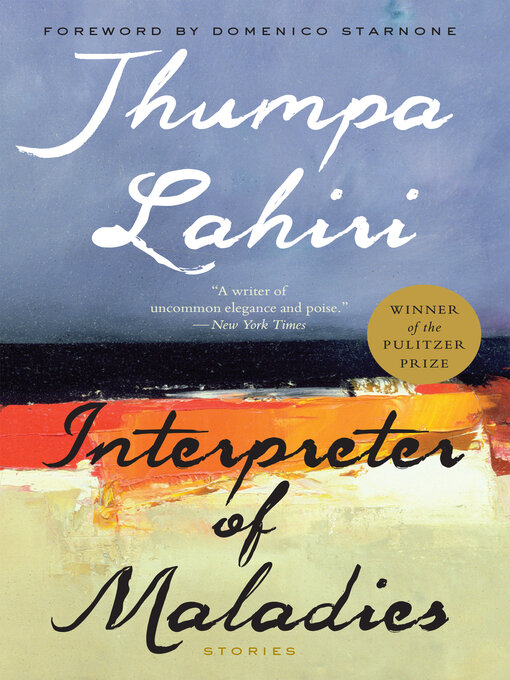
Interpreter of Maladies is an insightful collection of short stories that examines the experience of Indian immigrants from multiple angles. This is author Jhumpa Lahiri’s first published collection of stories, and it won a Pulitzer Prize. To quote the musical “Hamilton” – “Immigrants…we get the job done.”
This post may contain Amazon Affiliate links. As an Amazon Associate I earn a small commission, at no additional cost to you, from qualifying purchases. (This in no way affects the honesty of my reviews!) All commissions will be donated to the ALS Association.
I read Interpreter of Maladies as part of the 2024 Thoughtful Reading Challenge. May’s challenge was to read a book by an Asian American author in recognition of Asian American and Pacific Islander Heritage Month. Although born in London, the author moved to Rhode Island when she was three and has said, “I wasn’t born here, but I might as well have been.” She has also said that she has “felt intense pressure to be two things, loyal to the old world and fluent in the new.” That sentiment is a common theme throughout her short stories.
As an example, the titular story describes a very Americanized Indian family’s day trip to a historical site in India. The dysfunctional family includes three young kids, a dad with some impressive camera equipment, and an immature, detached mother who would rather paint her nails than interact with her kids or explore her heritage.
However, she does make an odd connection with her driver when she learns that his full-time job is as an interpreter for patients seeking medical services. She believes this gives him unique insights into medical conditions, and the driver is flattered by her attention and even begins to fantasize about the letters they will write to each other when she returns to the States.
Those dreams begin to dissipate when she makes a strange confession to him and as their day trip slides into disaster. At the end, he lets the scrap of paper with his address written on it flutter away in the breeze. He wants no further contact with her.
To me, the most compelling theme of this story is the complete indifference the mother showed to her heritage. She only became curious about her surroundings when she learned that the driver was an “interpreter of maladies”, and that curiosity was wholly selfish and superficial. Not only did she fail to capitalize on learning more about the land of her ancestors, but she also missed the opportunity to educate her kids.
This isn’t unique to immigrants from any particular country, and I believe assimilation is important to becoming the great melting pot that is America, but that doesn’t need to be done at the expense of forgetting your ancestors and where they lived.
I might be particularly attuned to this topic because my sister has been creating our family tree on Ancestry and she’s been finding very accomplished ancestors as well as scoundrels like Lizzie Borden and the last colonial mayor of NYC who was involved in a plot to kill George Washington. Okay, maybe not all of our heritage should be remembered.
Anyway, I enjoyed Interpreter of Maladies and recommend to anyone who likes good short stories or wants to learn more about the immigrant experience.
If you read a book written by an Asian American this month, please share what you thought!
For another terrific short story collection, check out my review of The Shell Collector by Anthony Doerr.
**Reminder – June’s challenge is to read a beach read. This should be good!
 Book Thoughts from Bed
Wait – you’re related to Lizzie Borden… really? I felt like you kind of buried that lede. :-). But I share your underlying question: Why visit your family’s homeland – and bring your children – if you aren’t planning to learn about your heritage while you are there?
I was not thinking of the May book challenge when I started reading “Nuts and Bolts: Seven Small Inventions That Changed the World (in a Big Way),” but it is written by Roma Agrawal, an Indian-British structural engineer, born in Mumbai, India, now living in London. The book provides a deep-dive look at seven key inventions: The wheel, the nail, the spring, the magnet, the lens, the string, and the pump. Agrawal traces their history and their impact on modern society through her personal lens as a woman engineer and a person impacted by Britain’s colonial domination of India.
I found every section fascinating, but I was particularly taken by her explanations of the magnet (the one invention originally found in nature) and how it led to the development of the compass, thus making long-distance exploration possible – leading to both great human advancement and wars and colonization of other people. Her description of the pump was also amazing, as that led to the modern inventions that make heart transplants possible, as well as the breast pump – which made it possible for new mothers returning to work to continue to feed breast milk to their babies.
I don’t read very much non-fiction, but this book was terrific. And the author’s ancestry as an Indian woman was influential in her approach to this engaging topic.
LikeLiked by 1 person
That sounds like a fascinating book! Thanks for telling us about it!
LikeLiked by 1 person
This was an interesting read. The theme of food was also prevalent in many of the stories which made me reflect on how we relate to our culture and heritage through our bellies–including the “culture” of our individual families. During our times stationed overseas, it was often a restaurant or meal that took us “back home”. I don’t typically read short stories but I enjoyed this format as well. Good pick!
LikeLiked by 1 person
Good point about food! There’s nothing like family traditions centered on recipes passed down through generations.
LikeLike
I really liked this book. Pulitzer Prize winner? That seems like a stretch but more likely that I’m not in touch with the Pulitzer Prize. I thought the short stories were fascinating and for the most part interesting. With a couple of them I was like, wait, that’s the end? My clear favorite was the one for which the book was titled. Throughout the book there are lots of emphasis on food, flowers, smells, and customs – those things we associate with “home,” in this case, India. Although the short stories were tales of immigrants and really could have been from anywhere, with this emphasis on the foods and customs, it really seemed to me that the book was written for the Indian expat population. Since I too enjoyed it, I guess that’s the great success of the book. The book touches upon the universal experience for anyone living out of their culture. Not a book I would have typically picked up so a great here’s to the 2024 Thoughtful Reading Challenge!
LikeLike