
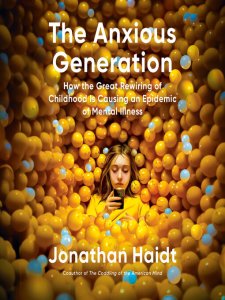
The Anxious Generation explores the fragility of Generation Z, effectively arguing that the cause of declining mental health among young people is a tectonic shift from a play-based childhood to a phone-based childhood. Kids are missing out on the growth that they get from unsupervised play – navigating face-to-face interactions with their friends, learning lessons and building confidence through risk-taking, etc. – at the same time they’re vulnerable to online bullying or indifference and receive alerts incessantly that they feel the need to react to. There’s a ton of good information in The Anxious Generation for parents, teachers, and anyone responsible for childhood development, including how to counteract the negative influence of a phone-based childhood.
This post may contain Amazon Affiliate links. As an Amazon Associate I earn a small commission, at no additional cost to you, from qualifying purchases. (This in no way affects the honesty of my reviews!) All commissions will be donated to the ALS Association.
I read The Anxious Generation as part of the 2026 Thoughtful Reading Challenge. January’s challenge was to read a self-help book since so many people are focusing on keeping their New Year’s resolutions this month. The Anxious Generation doesn’t mirror a typical self-help book, but it does include steps people can take to improve things. Okay, I may have bent the rules a bit because I’ve been wanting to read it.
Let’s start with a summary of The Anxious Generation.
After more than ten years of things either improving or at least holding steady, adolescent mental health took a sharp turn for the worse in the early 2010s. Depression, anxiety, self-harm, and suicide rates all spiked—many of them more than doubling. So… what happened?
Smart phones happened, that’s what.
In The Anxious Generation, social psychologist Jonathan Haidt digs into this troubling shift and lays out the data behind the teen mental health crisis that seemed to hit multiple countries all at once. From there, he zooms out to look at childhood itself—why kids need free play, independence, and real-world exploration to grow into capable, resilient adults. According to Haidt, the “play-based childhood” that many of us remember started fading in the 1980s and was essentially replaced in the early 2010s by something entirely new: the “phone-based childhood.”
He breaks down more than a dozen ways this massive shift has rewired kids’ social and neurological development. We’re talking everything from chronic sleep deprivation and fractured attention spans to addiction, loneliness, social comparison, perfectionism, and the way emotions spread online like wildfire. Haidt also explains why social media tends to hit girls especially hard, while many boys are retreating from real life into virtual worlds—with serious consequences for themselves, their families, and society as a whole.
What makes the book especially compelling is that Haidt doesn’t just point out the problems—he pushes for solutions. He explains the “collective action problems” keeping us stuck, including the “protectionism” that has parents swaddling their kids in bubble wrap and Karens calling 9-1-1 when they stumble across unsupervised kids at playgrounds.
The book offers four straightforward rules that could actually help turn things around.
- No smartphones before high school. This means parents have to remain strong in the face of intense peer pressure.
- No social media before 16. This topic made me cringe a bit. The current age of 13 was set somewhat arbitrarily by Congress back in the late 1990s and hasn’t been updated since. Additionally, there’s usually no age verification other than users checking a box to claim they are old enough to use the site, which, of course, isn’t a verification at all. The author advocates implementing a system that actually verifies age.
- Phone-free schools, from bell to bell. Honestly, what were educators thinking when they allowed phones in the classroom?!?!?
- More independence, free play, and responsibility in the real world. The author, who was inspired by the book “Free Range Children”, gave the example of how he let his young son walk to his New York City school, which gave him and the boy the confidence and trust needed to allow the son to ride the subway alone at the age of twelve. (That’s a little too free range for this mama bear.)
I’m really glad I read The Anxious Generation because it answers questions I had about why this younger generation seems so mentally and emotionally fragile. The counseling industry must be booming because every other Gen Z kid seems to be in therapy.
I believe the author’s theory that this fragility has to do with the fundamental shift in the nature of childhood. He provides plenty of data to support his theory, plus it passes my own “sniff” test. Intuitively it makes sense to me, particularly as the mother of two Gen Z kids.
While I was familiar with the downsides of social media for young people, I had never thought about the loss of development kids suffer by not having enough independent play time. That aspect was enlightening to me, maybe because I wasn’t conscious of the skills, independence, and confidence I was developing during my own very free range childhood. Again, that aspect of the author’s theory makes intuitive sense.
The book made me want to go back in time and do some things differently. Short of that, I recommend The Anxious Generation to anyone responsible for raising and teaching kids. But a word of caution – the book is HEAVY with data, and although they provide graphs and charts on their website, I suggest reading The Anxious Generation rather than listening to it.
If you read a self-help book in January, I’d love to hear about it!
**Reminder – February’s challenge is to read a book with the word “heart” in the title.

 Book Thoughts from Bed
I really liked this book too! Unfortunately, the message was quite disturbing regarding what is happening to young kids because of phones. Really fascinating how we as a group, collectively became afraid of the boogeyman outside yet left the doors and windows wide open for the more dangerous boogeymen on kids’ phones. I have requested to our children that before they have kids, to please read this book.
While I really enjoyed it, I agree that is should be read versus listened to. I listened to the first half while on a trip and then read the second half. He does have a lot of charts that obviously cannot be seen while listening to the book. The book is also an easy read since it is quite academic and he sums up what he says at the end of the chapter. A bit repetitive but helpful.
He makes his point quite solidly with data that phones really are negatively impacting our children. The logical follow up is, what are our phones doing to the rest of us? I can’t help but think that so much of the rage bait and vitriol out there is because we are all communicating through our phones instead of face to face. Not only is this book great for parents but it also made me rethink my own relationship with my phone. Just put it down!
LikeLiked by 1 person
Love the idea of asking your kids to read it before they have children!
LikeLike
Lots of academic stuff in this read, but I was struck by how quickly-a five year period-things fundamentally changed for children, ours included. Navigating the smart phone/social media minefield as a parent is/was daunting. And disturbing. I, too, liked that he gave concrete ideas of ways to combat this. Too often authors will lay out all the problems with no attempt at answers. It was a good read!
LikeLike