
Lessons in Chemistry chronicles the struggles of a woman scientist as she tries to succeed in a male dominated industry in the 1960s. It ranges from heavy to amusing, with a persistent hatred for Christians and the Catholic Church woven throughout (not amusing).
A summary of Lessons in Chemistry courtesy of Amazon:
“Chemist Elizabeth Zott is not your average woman. In fact, Elizabeth Zott would be the first to point out that there is no such thing as an average woman. But it’s the early 1960s and her all-male team at Hastings Research Institute takes a very unscientific view of equality. Except for one: Calvin Evans; the lonely, brilliant, Nobel–prize nominated grudge-holder who falls in love with—of all things—her mind. True chemistry results.
But like science, life is unpredictable. Which is why a few years later Elizabeth Zott finds herself not only a single mother, but the reluctant star of America’s most beloved cooking show Supper at Six. Elizabeth’s unusual approach to cooking (“combine one tablespoon acetic acid with a pinch of sodium chloride”) proves revolutionary. But as her following grows, not everyone is happy. Because as it turns out, Elizabeth Zott isn’t just teaching women to cook. She’s daring them to change the status quo.”
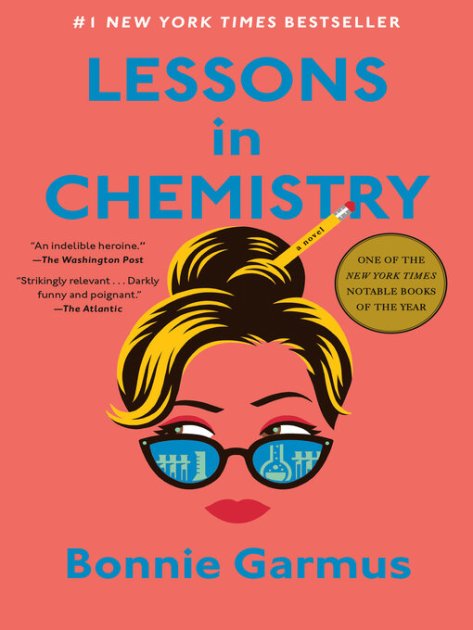
The novel has interesting characters and an original, engaging plot. The main character, Elizabeth, is complex – sometimes confident, sometimes vulnerable, but always inflexible. She reminds me of the main character in the TV series Bones, but with less charm. She is hard to like, but often easy to admire. The best scenes are those with Calvin and also those with the newborn baby because they make Elizabeth seem much more human.
The topic of sexism in the mid-20th century is also a good reminder of how far we’ve come thanks to women, like the character of Elizabeth, who pushed for change. However, the sexism may have been a little overdone. Two rapes / attempted rapes in the workplace are a little hard to believe.
As promising as this book is, the unnecessary anti-God and anti-religion themes ruined it for me. As examples, Christians and the clergy are blamed for Elizabeth’s gay brother’s suicide, psychologically tortured Calvin in an orphanage, and couldn’t even spell “heathen” correctly. So many worn out tropes. The one decent cleric in the story admitted that he didn’t believe in God. Who hurt you, Bonnie Garmus?!?!
Honestly, the Christian hate in the story was distracting and off-putting and ruined (for me) what could have been an exceptional novel. And the story didn’t even need that particular theme – it just felt like the author had an axe to grind.
Lessons in Chemistry is very popular and has received rave reviews, so my opinion might be in the minority. If you’ve read it, I would love to hear your opinion!
 Book Thoughts from Bed
Worn out tropes….that’s exactly it these days isn’t it? I just finished a book (to remain unnamed) and all I kept thinking while reading it was, seriously, this stuff again? And again? And again?! Ironically, it too had a good story line but was tainted by the axes that apparently still need sharpened. I’m convinced it must be a requirement to get published these days. Life is too short for bad literature!
LikeLiked by 1 person
I’m beginning to read the book and can tell that it is her first attempt at a novel. Its annoying that so many egregious things only happen to Elizabeth because she is female. For example, credit for her work being taken by her superior. This still happens today to interns and graduate students, both male and female. Its as if each chapter is designed to highlight a ne misery. Her Bombay (Mumbai) comment on page 35 is completely irrelevant. She didn”t have to go to India to describe poverty. She should have compared Mozart’s life to the life of the serfs living in Austria and Germany (Holy Roman Empire) at that time. It wasn’t until 1781 that Joseph II abolished serfdom when he signed the Serfdom Patent. However, the Patent was not equally enforced in the Hapsburg lands.
Anyway, I’m struggling through this book because it was the choice of the book club. Otherwise, I would not waste my time reading it.
LikeLiked by 1 person
Thanks for commenting! Sounds like it should be a lively book club discussion!
LikeLike
I gave up after chapter 9. Way too hateful towards Catholics.
LikeLike
I agree with you.
LikeLike
I disagree with George. As a woman starting out in the work world in the 1980’s we have come A LONG way. I think it’s important and valuable for the current generation to see what we had to deal with and how far we’ve come. For me, I was catapulted back tot he 80s and 90s and how I was treated. I was not in STEM, but I was in consulting and game development, both very male dominated at the time.
LikeLike
I do agree. I loved the book until the end when it had to be soooooo negative about religion. I had recommended it to many people and now am sorry.
There was no reason for everything about Catholics to be negative. So sad the author decided to include those parts. Totally unnecessary. Could have an amazing book. It was incredibly clever until the religion bashing.
LikeLiked by 1 person
Thanks for commenting! I agree – the negative Catholic theme ruined the book for me. I’m Catholic and I know the church has it’s problems, but it also does a lot of good across the world.
LikeLiked by 1 person
I totally agree! I was thoroughly enjoying the book, but the anti-Catholicism ruined it for me too.
LikeLiked by 1 person
I loved “Lessons in Chemistry “ except all the Catholic bashing. The author could have achieved the same result by making the religious bashing about brand X. The church, orphanage, and the Catholic parents of the biological mother could have all been of any unnamed religion. Every religion has bad stuff somewhere in their history but the author goes out of her way to bash Catholics.
My husband is now reading the book and I’m so tempted to warn him about the religion parts!
No longer looking forward to the streaming series. I can only imagine how Hollywood will treat religion!
LikeLiked by 1 person
Why in a book largely about the struggles of women is there such a blatant attack of religion and the Catholic Church? The writer lets her personal vendettas come into the story, thus spoiling an otherwise strong message. Now I feel that the sexism was overblown as well.
You can’t attack others in an attempt to boost up your own identity, ideology, theories.
It needs to be said that if this was how the writer portrayed non-Christian religions, there’d be more of an outcry.
LikeLiked by 1 person
Exactly! Thanks commenting, Roberta!
LikeLike
I also loved the book, and half way through recommended it to several friends. Then came the frequent religion bashing and anti God themes. As a Christian, I do not see the need for this and the overt references to the Catholic Church in a very negative way. It actually became a theme in the book! There were some hilarious parts, but the constant anti God ruined it for me too. Also sorry I told friends to buy it.
LikeLiked by 1 person
Thank you for commenting!
LikeLike
I totally agree, the negativity about Catholicism, clergy, and religion was a total turn off and seemed more like a personal vendetta. However, I appreciate these types of novels pointing out the struggles that women and minorities endured in the past because it shows that the issues we have today are not near what they were and how far we’ve come. It makes me think how silly we sometimes are lately with the things we complain about.
LikeLiked by 1 person
Hi Sloan! I agree – we have come a long way! I also totally agree with your last comment!
LikeLike
I too was taken aback by all the negativity not only towards the Catholic Church but to religion and the belief in God in general. It is difficult to believe that the author did not put aside her grievances toward religion to the extent that it permeated the book. I so enjoyed her style of writing , the unique story line and all the characters. But the permeating pounding of atheism felt like I was awakened in the middle of a good sleep by a very loud noise. I just wanted to shut it off … so very disappointing.
LikeLiked by 1 person
Great analogy! It became jarring and so distracting.
LikeLike
Could not agree MORE about the anti-Catholic, anti-Christian, anti-Jesus messages throughout the book. It became old as soon as it was heavily implied at the beginning of the book. I “persevered” and read to the end, but it was a GIANT waste of time. The author can turn a phrase quite deftly, quite creatively and quite cleverly, but her seething hatred of organized religion shows me that she is closed minded and has so many axes to grind that it becomes an unnecessary distraction from some decent writing. Don’t waste your time OR your money on this book.
LikeLiked by 1 person
Well put! Thanks for commenting!
LikeLike
I also found the anti God hostility really upsetting, it was like having my most treasured relationship totally trashed but in a way that was ill informed and lacked a morsel of intellectual rigor Women have come a long way but let’s use that for good 😊
LikeLiked by 1 person
Amen! Thanks for your comment!
LikeLike
Thank you for your honest review. I finished the book enjoying the character and the reminder of the struggles women have had and still do. Yet I also felt so discouraged by the negativity about faith, God and religion. I have stage 4 cancer and Jesus is my saving grace. I was wondering if I was being over sensitive but it has been good to see your comments and the comments of others.
LikeLiked by 1 person
Yes. I was off-put by it as well, but trying to not be overly-sensitive or closed minded so I kept giving it chances. It was definitely off-putting and I just couldn’t help but feel like she was employing a long list of tired tropes. So disappointing because it’s clear she can write, but that’s only half the battle – story and content is the other.
LikeLiked by 1 person
I enjoyed the book. The put-upon part early on made me think of “It’s a Wonderful Life” sort of. So many bad things happening one after the other. But the protagonist persevered and changed for the better what she could. She believed in science and is an atheist. Those are her beliefs and she explains that over and over. I respect and understand where she’s coming from. The. Catholic Church has much to answer for and really still hasn’t completely. What bothered me was where characters all came together, plot-wise. It seems contrived/too coincidental . However, I adore the dog, six-thirty!!
LikeLiked by 1 person
the dog, 6:30, was the bright spot of the book.
LikeLiked by 1 person
agree!
LikeLike
Annoyingly anti- Catholic. Also, hard to believe subject matter and topic. Thumbs down!
LikeLiked by 1 person
The anti-Catholicism in this novel disturbed me. The author’s story had many important topics that needed to be addressed, but her repeated anti-Catholic bias spoiled an otherwise worthwhile read.
LikeLiked by 1 person
1. Elizabeth is clearly coded as autistic & while I understand the time period would not have found her diagnosed as such it’s still frustrating to see it but not have it addressed. Particularly because then she’s just seen as cold, exacting, and immovable for no reason & her humanity (to many readers) is reduced to her motherhood & time as a married woman. Which, in itself, flies in the face of one of the book’s strongest themes, fighting misogyny. Perhaps it is intentional or it’s an unintended consequence, to show the reader’s own internal misogyny & lack of awareness regarding autism particularly in women. Still, though, if Garmus can set aside societal conventions to give Elizabeth her platform to speak, not only about misogyny, but also the Civil Rights movement, then she can feasibly give Elizabeth the Asperger’s (which we now know is just lower support needs Autism) diagnosis that would have been applied in the 60’s.
2. The misogyny in the work place is spot on. Some might view it as over the top, but before harassment laws were put in place women simply had no recourse & predators were left almost completely unchecked.
3. What some call “tropes” regarding religion, others call lived experience. Her brother’s suicide is not the outlier experience some might think it is, especially when you consider the time period. Homosexuality was still illegal at this time & the Catholic church (and Evangelical Christianity) has remained inflexible (ironic that it’s fine for the church but makes Elizabeth “unlikable”) towards the gay & trans community. Not to mention the rampant misogyny in this patriarchal religion (again, a main theme in the book). And, with the stories of people’s experiences in Catholic run orphanages, homes for unwed mothers (9,000 mothers & children, in Ireland alone, died), Indigenous children stolen from families & placed in (primarily Catholic but definitely religious) residential schools where children’s bodies are still being found, child sexual abuse by priests (and some nuns) that was covered up by the Church, it’s disingenuous to label this element of the story as just “tropes” because some reader’s find it distasteful to talk about. Even more when many of the people who’ve come forward are still faithful to the church.
4. Six thirty was, as most book dogs are, a sweet addition and it makes me miss having dogs.
LikeLike
Hello, Katie. Thank you for your comment. I’ll respond point by point.
1. Very good point. It honestly didn’t dawn on me that she was on the autism spectrum until I read that in an article after finishing the book. If I had known, I would have perceived her character differently. However, I still think the author could have made her more sympathetic, as Graeme Simsion did with the lead character in The Rosie Project (a great read, BTW).
2. Without a doubt, women in the workplace during that time period faced misogyny and there are still remnants of that today in corporate America. I’m grateful to all working women groundbreakers who paved the way for me to enter the Army and then have a successful business career. But I still think that two rapes in the workplace is overdone.
3. Instead of using the word “tropes,” perhaps I should have used the word “stereotypes.” In this day and age, we should all know the dangers and unfairness of painting large groups of people with broad brush strokes, which is what this author did. People associated with Christianity have done some horrible things, as you mentioned. But it’s also important to recognize the good things people of religion were doing during the 1950s and 1960s:
– Black Christian churches were a powerful driver of change during the civil rights movement. As an example, the Dexter Avenue Baptist Church, where MLK was the pastor, was at the heart of the Montgomery bus boycott.
– Other Protestant and Catholic church leaders often joined in the fight for equality. For example, here’s a a picture of Fr. Theodore Hesburgh (former longtime president of the University of Notre Dame) with Rev. Martin Luther King Jr., at a civil rights rally in Chicago. https://hesburgh.nd.edu/fr-teds-life/champion-of-civil-rights/martin-luther-king-jr/
– The Catholic Worker Movement, founded by Dorothy Day, was advocating for social justice and helping the poor across the country.
– Mother Teresa and other nuns in her order were ministering to the poor and dying in Calcutta. Other groups of Catholic nuns were performing similar acts of mercy around the world.
– World Vision, a Christian nonprofit, was helping children in Korea who had been impacted by war and poverty.
– Catholic Relief Services was working in 25 different countries to provide food and other assistance to those in need.
– You get the idea. For a recent example of Christian generosity, please read My ALS Story. https://bookthoughtsfrombed.com/2023/08/22/my-als-story-and-a-call-for-support/
Hopefully you now understand why I take exception to the author’s “Christians bad” approach. It’s not a black and white concept. In fact, it’s very complex. I didn’t call it a “trope” because I was being disingenuous. I called it a trope because it’s such an unnuanced – not to mention unoriginal – representation of Christians and Christianity. Treating the topic so one-sided like she did was cartoonish and lazy, not to mention distracting. What did it really add to the story? I would say nothing.
Thank you for providing a different perspective and for being respectful about it. I’ve received a few other comments disagreeing with my opinions, but they were a little too hateful to approve for posting.
And, yes, the dog was a lighthearted relief.
LikeLike
I was interested in watching the show based on this novel since the trailers looked interesting but after seeing the reviews, I definitely won’t bother. As much as I try and keep an open mind, I don’t see any benefit from reading a book that (according to all the comments) seems to openly bash any kind of Godly world view. Thank you for your wonderful blog and I will definitely be looking forward to reading more of your reviews. It’s refreshing to read your reviews and while I completely support people’s rights to decide what they choose to read, I also respect the right to decide what I don’t want to feed my mind on. You are an amazing inspiration and I will be praying for you and your family. God bless you!
LikeLiked by 1 person
Thank you for your comment and for reading my blog!
LikeLike
I agree with you. What could have been a good story was very offensive with the bashing of the Catholic Church. I love to read. And this book started out great but by the end I didn’t want to finish. And I definitely have no interest in watching the series or reading any other books by this author.
LikeLiked by 1 person
Yes, I’m going to pass on the series, as well. Thanks for commenting!
LikeLike
I totally agree. The anti-Christianity ruined for me what was otherwise an entertaining book. She certainly had an axe to grind. I wonder what horrible event happened to her when she was 13.
LikeLike
Thank you for commenting! Yes, it otherwise would have been an entertaining book.
LikeLike