
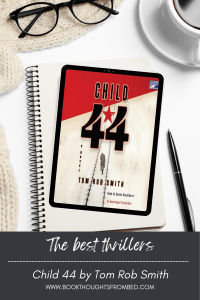
In Stalin’s Russia, thoroughly investigating a murder could be considered its own subversive crime, especially if the outcome tarnishes the State’s narrative of being a communist Utopia where citizens are so content that they never turn to crime. Against this backdrop, Leo Demidov, a member of the much-feared State Security Force (MGB), risks everything to track down a serial killer who is viciously preying on children.
This post may contain Amazon Affiliate links. As an Amazon Associate I earn a small commission, at no additional cost to you, from qualifying purchases. (This in no way affects the honesty of my reviews!) All commissions will be donated to the ALS Association.
I read Child 44 as part of the 2025 Thoughtful Reading Challenge. March’s challenge was to read a book set in the former USSR because two historical events happened during the month of March – Stalin’s death and a speech in which Churchill coined the phrase “Iron Curtain.”
This novel has an interesting premise that I’ve never considered before – crime fighting in an authoritarian regime. Given the State’s high level of surveillance of its citizens, it seems like identifying actual perpetrators would be an easy job. But ideology and an approach of presuming the guilt of all suspects means justice was often not the goal of the Soviet regime.
Here’s a quick summary of Child 44.
The novel opens with a harrowing story of starvation in Ukraine in the 1930s. Two young brothers can’t believe their luck – they see a scrawny cat scampering into the forest from a neighbor’s house. It’s been a long time since they’ve had any protein, and all the edible animals in the area had long since been eaten. The brothers think their luck is about to change for the better, but it actually worsens when one of the boys is attacked and carried off, presumably to be eaten.
Then the novel shifts to 1953. Two young brothers are having a snowball fight. One storms off and is found dead the next day by some railroad tracks. The party line is that he was hit by a train, but his family, in a rare show of defiance, pushes back by insisting that he was murdered.

One of the officers leading the “investigation” is Leo Demidov. Leo is a World War II hero who is fiercely devoted to enforcing the ideology of the Soviet State. This has often meant terrorizing his fellow citizens with unnecessary arrests and brutal interrogations.
Leo has a change of heart when a man he tracks down, suspected of espionage, is subject to one of these brutal interrogations, and Leo realizes he isn’t a spy at all. He’s just a veterinarian who treats the pets of employees of the nearby American embassy.
When the State comes after his wife Raisa for disloyalty, Leo refuses to denounce her. This leads to a demotion and a transfer from Moscow to the hinterlands. While there, he discovers murders similar to the boy who died by the train tracks.
His experience with the veterinarian and subsequent demotion were both turning points for Leo. He is no longer blindly loyal to the regime that treated him and others so badly. Leo, along with his wife and his boss, begin a secret investigation of the serial killings. What they find is shocking. Over 40 kids had been similarly murdered – the little boy by the railroad tracks was Child 44.
Investigating the murders despite the regime’s order not to puts the three at risk of arrest, imprisonment, and even death. They know the potential consequences but are committed to stopping the killer.
Sure enough, the authorities find out about the unauthorized investigation, which leads to Leo and Raisa being arrested, going on the run, and finally confronting the serial killer. During these hair-raising events, Leo and Raisa fall in love for the first time and the opening scene, in a surprising twist, finally makes sense. The death of Stalin and the subsequent regime change unexpectedly determine Leo’s and Raisa’s fates.
Child 44 is a satisfying suspense novel that fully leverages the secrecy, paranoia, oppression, and deep flaws of the communist Soviet regime. I felt immersed in the culture of suspicion where you can’t trust your neighbors, co-workers, government and even spouses. I can’t fully imagine living in a society like that, but this novel gave me a little taste of what it must feel like.
The plot of Child 44 is clever and well-crafted with good twists. The idea that thoroughly investigating a crime can be considered subversive and put a target on your back is unique and added a special element to the story. Although it took me a little bit of time to get into the story, it drew me in and held me with its constant action and revelations.
The characters are also interesting, especially Leo. There is a well-formed arc that takes him from being a cold tool of an authoritarian state to being a compassionate man who cares more about saving kids than toeing the line. I also like that the investigation brings him closer to Raisa and that they grow to care for each other.
I think readers who enjoy books set in Cold War Russia or who like a good thriller will like Child 44.
What about you? Did you take the challenge? Tell us about your book in the comments section!
**Reminder – April’s challenge is to read a book set in a US National Park.
And for another good book about a hellish communist society, check out my review of I Must Betray You.
 Book Thoughts from Bed
Whew – that sounds very creepy! I don’t think I’ve ever read a “regular” book set in the Soviet Union – what an interesting premise. I did just finish a terrific book about child abduction / murder set in the U.S. – The God of The Woods by Liz Moore. Highly recommended!
LikeLiked by 1 person
I’ve been eyeing that book. Thanks for the recommendation!
LikeLike
I really liked this book! Your review nails it – you can’t read this book without feeling just a small part what it must have been like to be alive in Stalin’s Russia. Is it any different today?! I enjoy books about Russia and the USSR. It’s a fascinating country but dang, they just thrive on paranoia. The all knowing, all powerful State is a force that must constantly be reckoned with, no matter what your position in society or the government for that matter.
Smith not only provides insight into Russian living but also puts together a pretty compelling suspense story as well. As you mentioned, there were many twists and turns and I certainly didn’t see the ending coming.
I enjoyed this one!
LikeLiked by 1 person
Thank for your comment! Studying the Soviet Union is an interesting look at a certain aspect of human nature. Stalin created a culture of suspicion and deprivation, yet many citizens mourned his death. Weird to me.
LikeLike
This was a great read, or in my case listen-to! I also liked the “arc” as you called it of Leo’s change in character. I agree that it was well-formed, as I think it could have come across as disingenuous. Certainly doesn’t make Stalinist Russia look like a garden spot. The fear of the state was palpable. Great suggestion!
LikeLiked by 1 person
You hooked me. I’m ordering the book.
LikeLiked by 1 person
Great! Please let me know what you think.
LikeLike
I read the Spy and the Traitor by Ben Macintyre for the 2025 Thoughtful Reading Challenge (March). Wow, what a great spy novel, and it’s a true story! As the subtitle describes, it’s “The Greatest Espionage Story of the Cold War.” And that description doesn’t disappoint. The novel follows KGB spy Oleg Gordievsky (secretly working with MI6) and American CIA agent Aldrich Ames (secretly spying for the Soviets) and how their paths collide in an unbelievable climax to the story. You couldn’t write a more intriguing work of fiction. I don’t want to give too much of the story away, but I highly recommend this book, especially to those who love a good spy novel!
LikeLike