
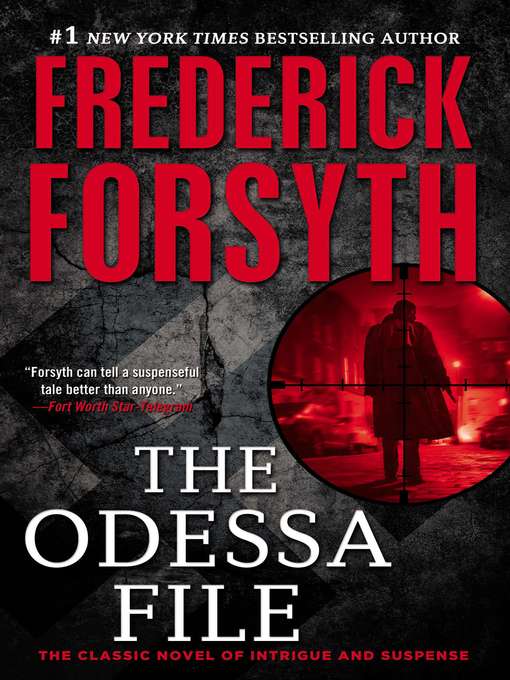
The Odessa File, published in 1972, is a gripping thriller set in 1960’s, postwar West Germany. A young German reporter is deeply moved by the journal of Holocaust survivor and sets out to find and bring to justice the evil commander of the ghetto where this Jewish man was held. By embarking on this quest, he unknowingly becomes part of an Israeli operation to thwart the efforts of former Nazi SS officers to wreak even more havoc on the world.
I read The Odessa File as part of 2026 Thoughtful Reading Challenge. June’s challenge was to read a book published in the year you turned six, since June is the sixth month of the year (one of my truly uninspired challenge categories, but it’s always interesting to read older books).
Here’s a quick summary of The Odessa File.
Peter Miller, a young German journalist, happens upon the diary of a Holocaust survivor who just committed suicide. The contents of the journal are shocking and horrific. In it, the Jewish man, Salomon Tauber, chronicled the wretchedness of the Riga Ghetto and the extreme cruelty of the camp’s commander, Captain Eduard Roschmann.
After reading the journal, Miller investigates Roschmann to find out if he was ever punished for his war crimes. This was at a time when an investigative journalist had to visit facilities to review source documents, so it took some time. After navigating bureaucratic red tape and general unhelpfulness, Miller discovered that the “Butcher of Riga” had never been brought to justice and, in fact, official information about him was rather sparse.
Miller wants to track this murderer down and he’s willing to face the dangers that accompany the task. His motivation is unclear. Is he just a man who strongly believes in justice? A young German who is trying to atone for his country’s past sins? At the end of the story, we find out that he has a very personal reason for hunting Roschmann.
His investigation catches the attention of an Israeli group that’s trying to stop a group called Odessa from gaining access to powerful missiles through a partnership with Egypt. Odessa’s primary mission is to protect former SS officers mainly by providing them with new identities. And, of course, the arrogant jerks haven’t given up on their dream of ruling the world and killing even more Jews.
The Israeli group recruits Miller to infiltrate Odessa, and thus begins an intense training period of all things SS, everything from uniform components to songs that make the murderers feel sooo self-righteous. Miller needed to be able to answer questions about his undercover identity quickly and accurately, and he’s ultimately successful at that. However, not being a fully trained, experienced spy is his downfall.
Miller almost penetrates the outermost shell of the Odessa fortress but then commits a rookie mistake that tips off the bad guys. He’s confronted, and it doesn’t go well for him.
I’m going to end the summary here but with a spoiler. At the end of The Odessa File, the SS scum once again suffer a humiliating loss. Very satisfying!
I’m glad I read The Odessa File. It’s hard to say you “enjoy” a novel with this particular topic, so I’ll just say it was worth my time. I lived in Germany when I was a baby in the mid- to late 60s and again when I was stationed there in the late 80s. It finally dawned on my self-absorbed self that these time periods weren’t that far removed from the end of World War II, especially the mid-60s when this novel takes place. During that time, a young SS officer would have reached his late 40s, still young enough to unleash more mayhem on the world.
This book is based on the notion that some of the former SS officers were still living comfortably in Germany under new identities. I hadn’t thought that – I naively assumed that they had fled to places like South America. I looked it up, and sure enough, it wasn’t unusual for them to stay in Germany and forge papers to acquire new identities. And with waning interest in bringing war criminals to trial, many of them were able to assimilate pretty easily with the rest of the population.
While I really like learning new things, it was difficult to discern fact from fiction in The Odessa File. And I was too lazy to look everything up. Further blurring the lines was the use of real people as characters. For example, Miller met with famed N*zi hunter Simon Wiesenthal. I guess this is my roundabout way of warning you that if you read The Odessa File, remember it’s a work of fiction and look up information if you want to know if it’s true.
Also, if you do read The Odessa File, know that Tauber’s diary, which is a fairly lengthy section near the beginning of the book, is really difficult to get through but its heartbreaking content is a critical setup for the rest of the story.
One comment on the narrator of the audio version of The Odessa File. He is a bit mechanical. It was kind of like listening to a vintage BBC radio broadcast. Maybe that was intentional?
I recommend The Odessa File for fans of spy thrillers and/or people who are interested in this particular topic.
**Reminder – July’s challenge is to read a book set during the American Revolution.
And on that note, happy 250th birthday, America!




I remember seeing this story when it came out as a movie in 1974 staring Jon Voight. It was scary & intriging. It would be interesting to listen to the audio book. Thanks for the excellent review.
LikeLike
Well, I’m a little late but I just finished it as well! Great review, Michelle. I really enjoyed the book and as you said, the challenge was in trying to discern fact from historical fiction. I guess if you are writing a book, that is a good thing? Although a lot of the novel was fiction, it certainly was educational for a period not that long ago. Having recently visited Riga, I was intrigued that that was the location of the concentration camp. Oh, and that is a factual place unfortunately. I don’t usually like to listen to books because they often seem slower than if I am reading them but this one kept my attention. It was suspenseful and intriguing and I also learned a lot from a historical perspective.
What was amazing to me was that even though this book was written over 50 years ago, many of the topics were pertinent and relevant to today’s world. I found the discussion of collective guilt interesting and enlightening. Also, there was a quote that I found quite appropriate and timely for today’s “journalism.” It was something like “Never let journalism get personal. It’s bad for the reporter and it’s bad for the reporting.” Amen!
Perhaps my favorite thing about this book was listening to the British accent. I had many a laugh at the pronunciation differences. Also, Miller’s car got a lot of time. You know, the Jag You Are (Jaguar). 🙂
LikeLike