
The Gales of November was published in 2025 to commemorate the 50th anniversary of the wreck of the Edmund Fitzgerald, which sank during a “storm of the century” on Lake Superior on November 10, 1975. Since all those on board perished, we’ll never know exactly what happened, but the author describes several theories including the possibility that it was a combination of factors – a perfect storm of unfortunate events, if you will – that caused the “Mighty Fitz” to sink into the icy waters of Lake Superior.
This post may contain Amazon Affiliate links. As an Amazon Associate I earn a small commission, at no additional cost to you, from qualifying purchases. (This in no way affects the honesty of my reviews!) All commissions will be donated to the ALS Association.
I read The Gales of November as part of the 2026 Thoughtful Reading Challenge. September’s challenge was to read a book centered on a profession in honor of Labor Day. I can now cross Great Lakes sailor off my list of Careers I Wish I Had Explored. To paraphrase someone interviewed for the book, it’s a job that’s steadily boring with moments of sheer terror mixed in. Not for me, but kudos to everyone in that profession!
The Edmund Fitzgerald was christened in 1958. At the time, it was the largest boat sailing on the Great Lakes, with a deadweight capacity of 26,000 long tons. She regularly set records while hauling iron ore across the Great Lakes. (As a side note, it was interesting to learn about the economic boom some of the Northern states, especially Michigan, experienced due to the iron mined from the Iron Mountains during and immediately after World War II.)
With its size, impressive records, and a captain who piped music through the ship’s sound system, the Edmund Fitzgerald soon became a favorite among maritime fans. The ship was a bit of a celebrity, and a popular one at that.
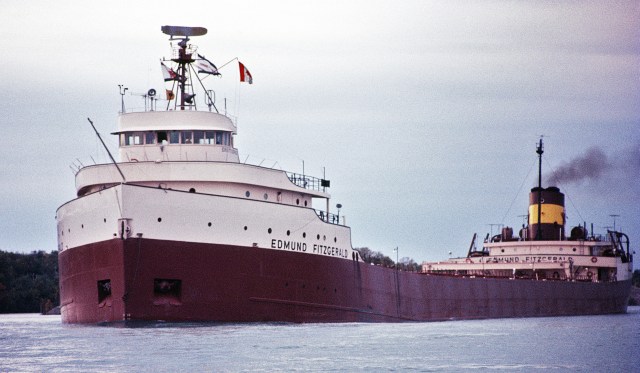
It was also outfitted with top-of-the-line amenities. For example, the cooks used the state-of-the-art kitchen equipment to produce food that was said to be the best of any freighter on the Great Lakes. All these characteristics – a stellar reputation, a proven track record, and, yes, amazing food – made the ship an elite employer. Getting a job on the Edmund Fitzgerald was a desirable assignment, especially because it was considered unsinkable.
The crew was a mix of seasoned and green sailors, and the captain, Ernest M. McSorley, was considered the best on the Great Lakes. After that November trip, McSorley and some of the other crew members planned to retire, while the ship was scheduled to go in for maintenance. Unfortunately, that wasn’t in the cards.
The ship set sail on November 9, 1975, from Superior, Wisconsin, on her way to a port near Detroit, and with a full load of iron ore. The afternoon was warm and a blue sky belied the impending storm. But two weather fronts were on their way, and their collision would create catastrophic conditions. The Edmund Fitzgerald was in the epicenter of this “storm of the century.”
But she was not alone. Another freighter, the Anderson, had set sail around the same time. They initially seemed to be racing in what was a friendly competition. However, as the weather worsened, the Anderson slowed down, while the Fitz remained full steam ahead, despite Captain McSorley not being very familiar with the route he had chosen in an attempt to avoid the worst of the storm.
The captain of the Anderson tracked the Edmund Fitzgerald on his ship’s radar system and was in radio contact with McSorley. He saw on his radar that the Fitz passed too closely to a small island, and one theory for the ship’s demise is that the bottom of the ship was damaged when it ran into nearby shoals.
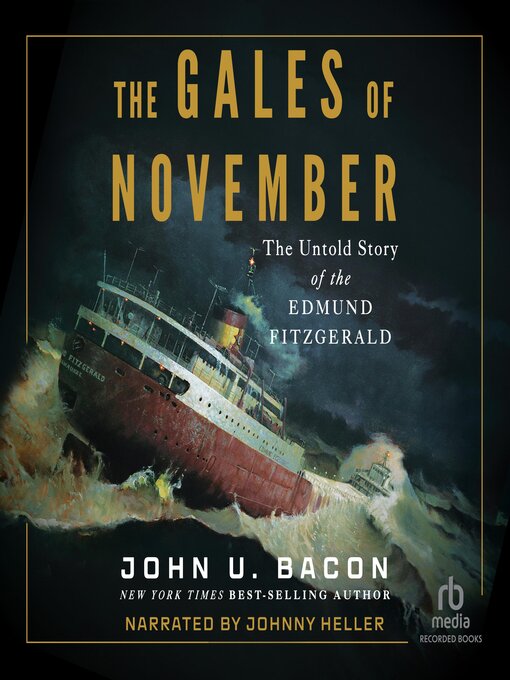
At one point, McSorley radioed that the ship was listing. His last transmission was, “We are holding our own”. And soon after, the Edmund Fitzgerald disappeared from radar and sank to the bottom of Lake Superior, only a little over an hour from her destination and safety. All 29 crew members perished.
There are many factors that should be considered when developing a theory about why the ship sank. In addition to the possibility that the Fitz had bottomed out on the shoals:
- The ship had been designed to be bend-y
- It was put together primarily with welds rather than bolts/rivets (a stronger option), and many of the welds were reportedly cracked
- It was overloaded with iron ore, a common practice at the time because cargo = money
- The ore, called taconite, was made of absorbent clay that, when soaked, could weigh 7% more
- Captain McSorley was sleep deprived and the constant rocking of a boat can affect people’s minds (it’s a thing), so human error may have been a factor
I like the theory that several factors contributed to the wreck, because it just makes sense to me.
Following the wreck, the family and friends of the crew petitioned to have the ship designated as grave site to keep the lookie loos away (all the bodies are likely still trapped within the ship and the families decided not to recover them). Additionally, the wreck was memorialized by Gordon Lightfoot, who came to know the surviving families, in his hit song, “Wreck of the Edmund Fitzgerald.”
If the song is now stuck in your head, you’re welcome.
I’m glad I read The Gales of November. It is very well researched and written. I remember Lightfoot’s haunting song from when I was a kid, and I was intrigued to learn more. There’s a lot of depth to the story.
I like nonfiction that teaches me things, and The Gales of November delivered. For example, I never knew about the huge economic impact of Great Lakes shipping, nor was I familiar with all the iron ore that was mined from the Iron Mountains (which I had never heard of). Honestly, my main experience with a Great Lake was that it was responsible for an abundance of snow being dumped on my college town.
As awful as that was, it doesn’t compare with what sailors experience during a storm on the Great Lakes. I never thought of lakes having waves, but the crew of the Fitz was facing up to 35-foot waves and near hurricane winds. Something else I never thought of – because lake water isn’t salty, it freezes much more quickly than sea water and can coat a ship with several inches or even feet of ice. So, in addition to an overweight cargo, the freighter was likely carrying a lot of extra weight from the ice.
I also liked that the author provided context by, for example, discussing previous shipwrecks. It’s an effective way to set the stage for this particular disaster.
Most importantly, he did his due diligence in researching many of the crew members, which must have been challenging given that the wreck happened fifty years prior to The Gales of November being published. He used the information to highlight the real tragedy of the wreck – the loss of 29 lives.
Thumbs up for The Gales of November. I think anyone who enjoys learning about significant historical events will get a lot out of it. And Baby Boomers and Gen X readers who remember the song and want to know the story behind it will be glad they read it.
Did you read a profession-centered book in September? Please share!
**Reminder – October’s challenge is to read a book with “library” or “bookstore” or “bookshop” in the title.


Wow – your review gave me shivers! It reminded me of the recent Titanic exhibit at Union Station, where we learned that several variables combined to sink an “unsinkable” ship. I’ve always loved that Gordon Lightfoot song – though I used to think it was about “the wreck of the Ella Fitzgerald” – hah! Thanks for a very thoughtful and interesting story on a cold and rainy autumn day!
LikeLiked by 2 people
The story is definitely goosebump-inducing, and reminded me, as well, of the Titanic and maybe even the Hindenburg.
Ella Fitzgerald! LOL!
LikeLiked by 1 person
Loved your review Michelle! I have been intrigued with the Edmund Fitzgerald ever since she sank and became even more intrigued when the song came out.
I just finished a profession centered book No Bullet Got Me Yet by John Stansifer which focuses on the risks of being a military chaplain, centering on Fr Emil Kapaun from Pilsen KS who died in the Korean War. It’s very enlightening and well done.
LikeLiked by 2 people
That sounds really interesting! Thanks for the recommendation!
LikeLiked by 1 person
I loved that book Kevin! Father Kapaun, a Kansas native, was really special. Loved how soldiers of all faith backgrounds sang his praises.
LikeLiked by 1 person
Sounds like my kind of book!
LikeLiked by 2 people
It’s a good one!
LikeLike
Great review Michelle! So glad you liked the book. I too read this one and really enjoyed it. I think all of us from our era can sing most of the song by Gordon Lightfoot. When I finished the book, I listened to it a couple of times. Even appreciated it more. Also like how the author included information about the song and Lightfoot’s reaction to it becoming a hit.
I found the book fascinating that such a large ship could sink on a lake, not an ocean. But then, if one has spent much time around the Great Lakes, you know they’re called great for a reason. I too was fascinated by the historical and scientific information. I did not know that there was a difference in fresh water waves and saltwater waves and the difference makes the fresh water waves even more dangerous. Also, the sheer volume of water in the lakes, particularly Superior, is also almost unfathomable. We visited Whitefish Point a few years ago and went to the Great Lakes Shipwreck Museum. It’s a humble little museum but almost unbelievable how many ships have sank in the lakes and particularly in Superior. Further, it is amazing how cold lake Superior stays, even in the summer time due to its great depths. We went out to Isle Royal National Park and I could not get over how cold it was during the crossing because of how cold the water was yet on shore, it was over 80 degrees. Obviously as Bacon explained, even if someone survived the sinking of their ship, the odds of surviving in the water for very long were virtually nil. I also was fascinated by the idea of motion fatigue and that the US Navy has actually studied it. Not hard to believe that it would begin to take a toll, especially in such high seas and with so little sleep. Perhaps the only critique I had of the book was that there were a few too many personal stories? I know many people like that portion but I could have done with a few less. Still hard to believe that this was McSorley’s and his first mate’s last voyage. What are the odds?
Finally, shortly after finishing the book, we were in Fayetteville, WV. Believe it or not, I saw a car with a bumper sticker that said Never Forget the Edmund Fitzgerald. I couldn’t help but wonder if they knew someone who was on board on that tragic day.
LikeLike
Thanks, George! Your comments are always insightful, but this one is especially fascinating! The little museum sounds worthy of a visit, and what are the odds of seeing that bumper sticker in a random place?? I’m glad you found this book for us. Great read!
LikeLike
Your review convinced me that this book would be well-loved as a gift for people who love riveting non-fiction tales. Thanks for the review.
LikeLiked by 1 person
My pleasure!
LikeLike