
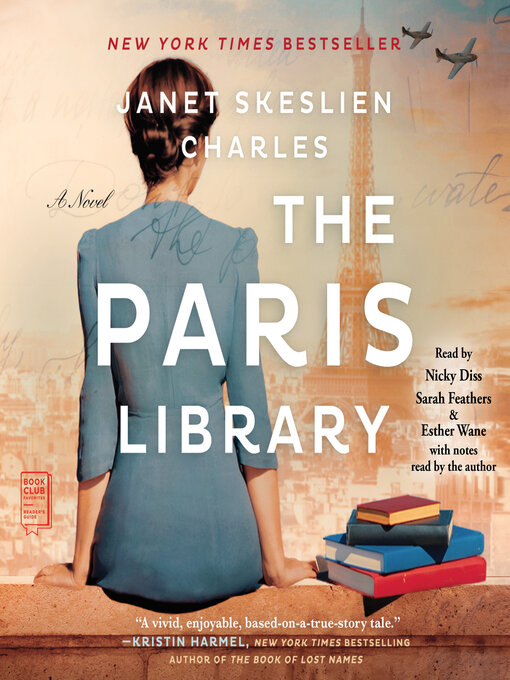
The Paris Library is historical fiction based on the true story of the American Library in Paris, which managed to remain open during the German occupation in World War II. The main character is young librarian Odile Souchet who, along with her coworkers, defies the occupiers in the best way she can – primarily by smuggling books to the library’s Jewish subscribers, who were recently banned from entering the building.
This post may contain Amazon Affiliate links. As an Amazon Associate I earn a small commission, at no additional cost to you, from qualifying purchases. (This in no way affects the honesty of my reviews!) All commissions will be donated to the ALS Association.
I read The Paris Library as part of the 2026 Thoughtful Reading Challenge. October’s challenge was to read a book with “library” or “bookstore” or “bookshop” in the title because October is National Book Month. There are plenty of options in this category, but World War II fiction is my jam.
Let’s begin with a summary of The Paris Library.
Young Odile has a lot going for her – a job that she loves, a boyfriend who adores her, and a supportive family that includes her twin brother. A bookworm by nature, she’s blissfully surrounded by books at work and has coworkers that share her passion for the written word. She has even memorized the Dewey Decimal System and frequently blurts out numbers when she discusses books.
A good part of the story is told from her point of view, and we learn about her family and friends through her eyes. Her father and beau are both police officers; brother Remy is studying law but his heart isn’t in it; Remy’s girlfriend, Bitsy, works with Odile at the library, as do Boris, a Russian refugee, and Margaret, an English woman married to a diplomat. One of Odile’s favorite subscribers is Professor Cohen, a Jewish woman who teaches college and is a budding novelist. And Odile is fortunate to work for a woman she respects, the American director.
Odile’s comfortable, happy life takes a tragic turn when France and Germany go to war. Her brother joins the army and is captured at Dunkirk. The Maginot Line failed to hold, and soon the Germans are rolling into Paris. Odile and her fellow librarians must now contend with persecution of some of their staff and regular patrons, extreme food rationing, uncertainty about military family members and friends, neighbors snitching on them, and being required to take certain books out of circulation because the N*zis deemed them subversive.
As the librarians struggle to keep the library open and minimize the disruption to their subscribers, they also join the Resistance in their own way, primarily by smuggling books to those who could no longer visit the library. The staff believe so strongly in the power of knowledge and a good story that they risk getting caught at one of the numerous German checkpoints in the city.
When the war finally ends, Odile rejoices, despite a tragic personal loss. She looks forward to a future where she can finally marry her boyfriend and start the next chapter of her life. But a ghastly betrayal has her fleeing the country, and she winds up, of all places, in Montana.
Fast forward to 1983, nearly forty years in the future. In a small town in Montana, teenaged Lily longs for something more exciting. She’s curious about her French neighbor, whom locals have dubbed “The War Bride”. When a school assignment provides an opportunity to interview the woman, Lily jumps at the chance. Lily and Odile form a connection, and then an unlikely friendship.
Suddenly, widowed Odile finds a renewed purpose in her life. She gives Lily French lessons and is drawn into helping Lily’s stepmother with her infant sons. She also becomes a sort of mentor to Lily, providing her with motherly advice as Lily tries to navigate being a teenage girl. They hit a rocky patch, but they love each other too much to let it permanently damage their relationship.
Overall, I liked The Paris Library. It’s not in my top ten favorite World War II or historical fiction novels, but it had several strong points. I didn’t know about the American Library in Paris, and I like that the author paid homage to a group that was so passionate about the written word. I also like that they found their own way to resist. Major, ceremonial book burnings were orchestrated by student groups that supported Hitler in 1933, and the German army continued to ban and censor books and shut down libraries throughout the war. The librarians weaponized what the N*zis clearly considered dangerous. Clever!
The author also did a nice job developing the characters and contrasting Paris before and during the occupation. She was honest about the good, the bad and the ugly including how citizens turned on each other during the occupation and used vigilante justice on those they considered to be N*zi sympathizers. I also like how she switched back and forth between two time periods so the reader got to hear about “old” Odile.
What I didn’t like was that there were several loose ends that weren’t tied up. For example, what happened to the people she left behind in Paris?? I also had an issue understanding the main reader in the audio version of The Paris Library. She spoke rapidly with a French accent and would lower her volume during poignant moments. I had to rewind a few times to catch what she said.
I would encourage fans of historical fiction and World War II novels to consider adding The Paris Library to your reading list. And if you go with the audio version, be prepared to pump up the volume.
Did you take October’s challenge? Please share!
**Reminder – November’s challenge is to read a book by Mark Twain.